
By Nick Munn, Archives and Manuscripts Placement Student
‘This wonderful man died… having done for the elucidation of English church history… more than any one before or since.’
The glowing testimony above could have applied to any of the United Kingdom’s most influential antiquarians, such as Bishop William Stubbs (d. 1901). Instead, it is Stubbs’ own testimony in memory of another, lesser-known church historian, whose name has to a large degree passed out of modern parlance. His name was Henry Wharton.
Wharton led a meteoric yet short life. Born in November 1664, and dying before his thirty-first birthday, Wharton was educated at Cambridge, ordained deacon in 1687, and priest the following year. He was a man of great learning and religious zeal, but one who would die an embittered man believing both his literary efforts and hopes of clerical advancement were uncredited and unrealised. Despite this, Wharton’s burial was one of great pomp in Westminster Abbey, where his tomb and memorial tablet can still be visited in the nave.

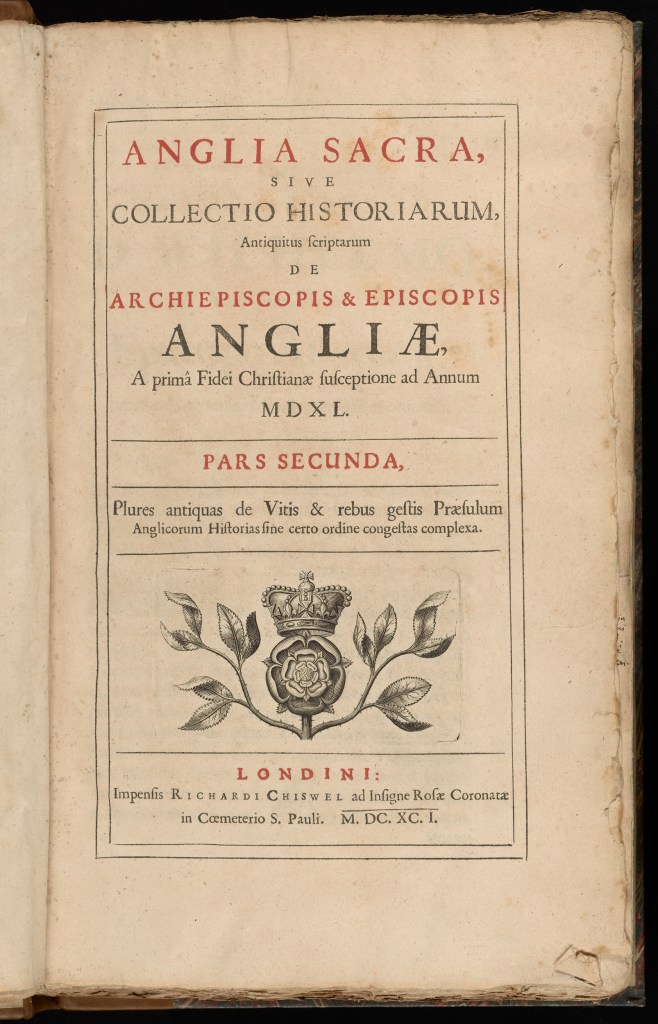
Wharton’s career was one defined by over-zealous study. His death by tuberculosis in 1695 was believed by his contemporaries to have been caused in part by his scholarly industry. Wharton wrote at least eleven large works and contributed to many other publications. His catalogue (MS 580) of the manuscripts at Lambeth was the first to be numbered sequentially. The greatest and most famous was the two-volume Anglia Sacra (1691), a collection of documents relating to English ecclesiastical history until the year 1540. He died before the completion of a planned third volume, a portion of which was published as Historia de episcopis & decanis Londinensibus… (History of the bishops and deans of London…) (1695).
One manuscript which contributed to Anglia Sacra is Lambeth Palace Library’s MS 593. Originally referenced ‘X’ (for Wharton categorised his manuscripts alphabetically), it contains an eclectic mix of his transcriptions of pre-modern documents held in numerous archives across England. There does not appear to be any pattern within the manuscript; the transcriptions are not in date order, or even grouped by region; instead, they are likely categorised in the order in which Wharton found them. Nevertheless, Wharton did include a contents page (image below), suggesting that there was method to his madness. This is the case because Wharton transcribed many of these documents for his Anglia Sacra; most of the documents in the manuscript indeed appear within either volume.

Of note in MS 593 are five sources relating to medieval heresy. Wharton included extracts from the works of John Wycliffe (d. 1384), Reginald Pecock (d. circa 1461), and Roger Dymock (d. circa 1400). Wycliffe and Pecock were noted supporters of church reform, something which would see their works condemned as heresy and publicly burned. Dymock, alternatively, is known only from his work against the ‘conclusions’ of the Lollards, followers of Wycliffe’s proposed reforms. The inclusion of these works seems odd at first glance. They are different in character – being treatises – compared to the other works which by and large are annalistic, hagiographic, or lists of important churchmen with biographic information. Why did Wharton include them?

One possibility is apparent. The period in which these items were likely transcribed, 1688-1691, coincided with the Glorious Revolution in England. Wharton had made the acquaintance of Archbishop William Sancroft (d. 1693) in January 1688, as the overworked assistant to the historian William Cave (d. 1713) and soon found himself among Sancroft’s favourites and one of his chaplains. In May of that year, Archbishop Sancroft and six of his bishops refused to read King James II’s second Declaration of Indulgence. The Declaration intended to give more religious freedoms to Roman Catholics and Protestant Dissenters. They were subsequently imprisoned in the Tower for seditious libel, being released in June following a public outcry. Despite this, Sancroft would later refuse to swear allegiance to the new king William of Orange, a decision which cost him his archbishopric in 1690. Wharton, however, was the only one of Sancroft’s chaplains who remained with him throughout.

MS 593, along with Wharton’s other surviving manuscripts, is the remnant of an overzealous scholar seeking to create, among other works, a pre-reformation history of England. It reflects the vast range of documents that Wharton considered as encapsulating the life of the English church and its custodians. Yet it also reflected a different history, one much more present for Wharton. His editorial decisions reflect the crises of his own times and the religious conflicts that dogged his association with Archbishop Sancroft.
Bibliography:
Primary Sources:
Sancroft, William, Letter from William Sancroft to Thomas Sprat, April 12th, 1693. Lambeth Palace Library, London: MS 4696, f. 8.
Wharton, Henry, Anglia Sacra, vols. 1 and 2 (London: Richard Chiswel, 1691).
Wharton, Henry, X 593 – Historiae aliquot Ecclesiasticae de rebus Anglicis, Ex Codicibus MSS. descriptae. Lambeth Palace Library, London: MS 593.
Secondary Studies:
The Editors of Encyclopaedia Britannica. “William Sancroft.” Encyclopedia Britannica, January 26, 2025. https://www.britannica.com/biography/William-Sancroft. Accessed: 03/07/2025.
Holden Hutton, William, Wharton, Henry (1664-1695), Dictionary of National Bibliography, vol. 60 (1899), pp. 404-407.
Kenyon, John P. “James II.” Encyclopedia Britannica, May 19, 2025. https://www.britannica.com/biography/James-II-king-of-England-Scotland-and-Ireland. Accessed: 03/07/2025.
Wright, Alexander R., ‘William Cave (1637-1713) and the Fortunes of Historia Literaria in England’. PhD diss., Sidney Sussex College, Cambridge, 2018.
Further reading:
Duffy, Eamon, The Stripping of the Altars: Traditional Religion in England, 1400-1580, second ed. (New Haven and London: Yale University Press, 2005).
Johnson, Ian, ‘The ‘Goostly Chaffare’ of Reginald Pecock: Everyday Craft, Commerce and Custom Meet Syllogistic Polemic in Fifteenth-Century London’, in Religious Practices and Everyday Life in the Long Fifteenth Century (1350–1570): Interpreting Changes and Changes of Interpretation, ed. Ian Johnson and Ana Maria S. A. Rodrigues, New Communities of Interpretation, 2 (Turnhout: Brepols, 2021), pp. 175–199.
Lane-Poole, Reginald, Dymock, Roger (fl. 1395), Dictionary of National Biography, vol. 16 (1888), pp. 293-294.
McFarlane, Kenneth Bruce, John Wycliffe and the Beginnings of English Nonconformity (New York: Macmillan, 1953).
McSheffrey, Shannon, ‘Heresy, Orthodoxy and English Vernacular Religion 1480-1525’, Past and Present, 186 (2005), pp. 47-80.
 A Monument of Fame