
By Katie Small, Assistant Archivist
As a result of the “Not Strangers but Pilgrims Inter-Church Process” the British Council of Churches (BCC) ceased to exist on 31 August 1990 to be replaced the following day by a new ecumenical body, the Council of Churches for Britain and Ireland (of which the Catholic Church was a part). In 1999 this new body was renamed to become known as Churches Together in Britain and Ireland (CTBI).
The CTBI collection covers all aspects of the organisations work, and demonstrates the importance of ecumenical collaboration, both in the UK and internationally. The ‘Not Strangers but Pilgrims’ process built on the work of the BCC and brought new organisations into the ecumenical fold. This allowed for a greater scope of work, and showed ambitious collaboration, particularly in education and international affairs.
In the 1990s and 2000s, CTBI were particularly active in the provision of scholarships and pastoral assistance to overseas students studying in the UK. This work was largely done through the Churches International Student Network, previously known as Churches Commission on Overseas Students (CCOS) and Churches Commission on International Students (CCIS). The newsletters of CCOS show the wide-ranging work of the commission (CTBI/EDU/1/2).
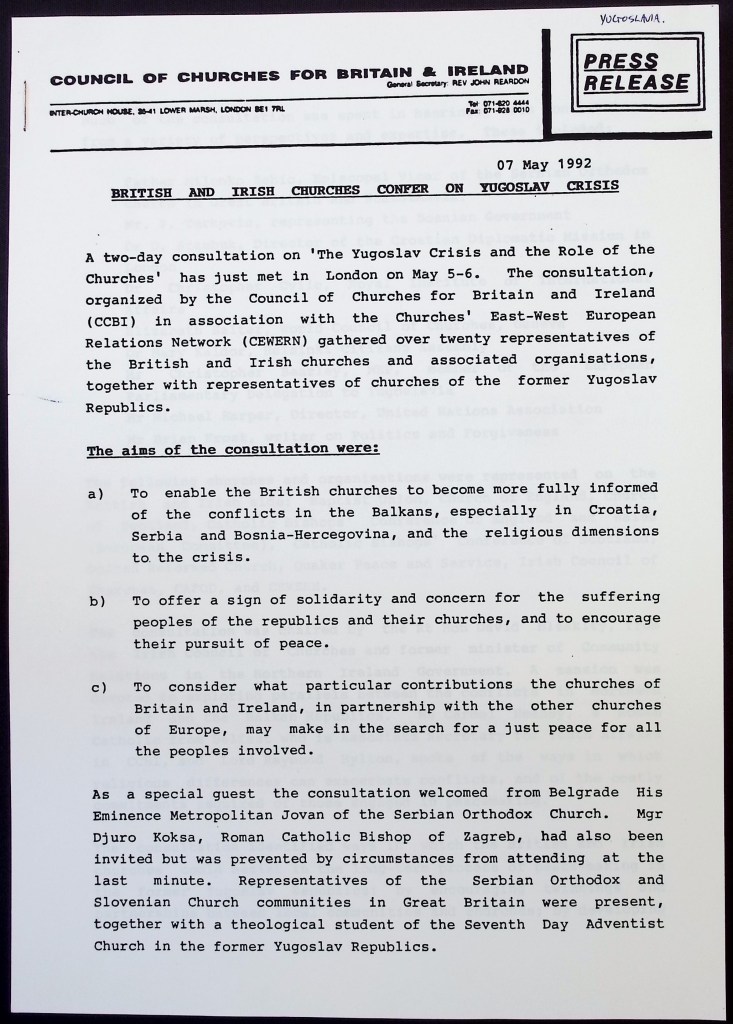
The major events of the 1990s can be tracked through the records of CTBI, and papers currently available include a service of remembrance for the Gulf War (CTBI/INT/8/5/6), the 1994 elections in South Africa, the first to be held with universal suffrage (CTBI/INT/7/9/11) and an ecumenical church delegation visit to former Yugoslavia in 1992 (CTBI/INT/9/15/2).

Unique to the CTBI cataloguing project was an issue with mould caused by damp basement storage. Most of the collection was deemed to be in good condition and free of pests, as the collection had previously been held at the Church of England Record Centre (CERC).
Additional deposits of material had been held in damp conditions and were mouldy on arrival at Lambeth Palace Library. The files were immediately placed into sealed boxes and stored in a quarantine room, to ensure the mould did not spread to other collections.
Members of the Collections Care team at Lambeth Palace Library started by isolating the mouldy documents to halt the spread to others and used a freezer to ensure no further growth of the mould for those most impacted. Before putting in the freezer, files were double-bagged in case of freezer malfunction, and so no crystals would form on the actual documents and cause further damage.
For cleaning, chemical sponges or soft bristle brushes were used to wipe away surface mould, as anything firmer could have caused damage to the surface of the papers. During the summer months, cleaning took place outside to reduce the risk of harm caused by mould spores.

The cataloguing project lasted 19 months and demonstrated the intricacies and difficulties of cataloguing modern records. Whilst on the face of it, a modern collection consisting largely of paper looks unproblematic, it is anything but.
Records from the 1990s and early 2000s show the rapid change in technological development. The advent of readily available computer technology gave people the opportunity to produce vast quantities of paper records. The office printer and the fax machine also contributed to this, with the latter presenting particular difficulties. The CTBI collection contains many examples of faxes, some of which are badly faded.
The CTBI collection also contains a large amount of audio-visual and removable media, such as VHS tapes, floppy discs and USB drives. The availability of different media formats enabled people to create, distribute and store their work in more ways than ever before. The purchase and use of this media was, in comparison to reel film, easy and affordable. Archivists of modern collections are faced with a huge quantity of this media, and it is incredibly challenging to convert this material into a format that can be viewed by researchers and keep the integrity of the original format of the material.
CTBI continues to work on strengthening ecumenical partnerships to help Churches and organisations across England, Ireland, Scotland and Wales build relationships with communities and campaign on important issues, such as Racial Justice, Global Peace and Youth Work. The foundations for this work can be seen in the CTBI archive, held at Lambeth Palace Library. The CTBI collection spans 1990-2018, and records are released in line with closure policies. After 30 years, barring any longer closures, records at Lambeth Palace Library are opened to the public. Currently, records up to 1994 are available to search on the Lambeth Palace Library archive catalogue and then consulted in our reading room. Details about how to register as a reader and visit our reading room can be found on our website.
 A Monument of Fame