
The project to catalogue the Act Books of the Court of Arches from 1677 to 1690 (Arches A 13 – A 19), generously supported by the Friends of Lambeth Palace Library, has been successfully completed. A total of 35,221 acts of court have now been recorded and dated for the first time and the entire catalogue of the Arches archive for the years 1660-1690 has been substantially corrected and enhanced.
![Title page of Edmund Hickeringill, The test or tryal of the goodness and value of spiritual courts… 3rd ed. [1706?],](https://monumentoffame.org/wp-content/uploads/2023/06/h5133.h52-1-13.jpg?w=582)
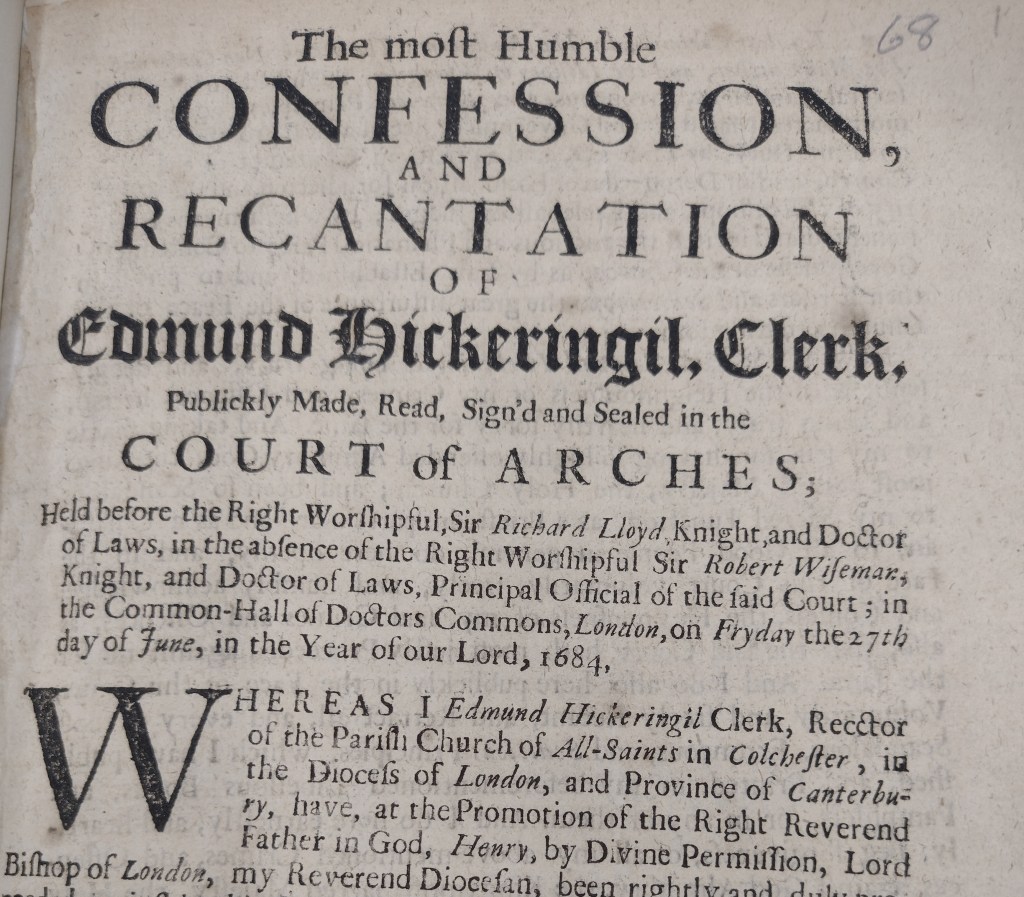
Included was the suit brought by Henry Compton, Bishop of London, against Edmund Hickeringill, Vicar of All Saints, Colchester, for performing clandestine marriages. A prolific pamphleteer, many of Hickeringill’s broadsides were fired against the church courts. When brought before the Court of Arches in 1681 he refused to recognise its authority, denounced the advocates as inferior to him in learning, and refused to remove his hat in deference to the Judge. An usher of the Court snatched it off and a tussle ensued. Hickeringill also baffled the court by speaking only in ancient Greek and completed his performance by throwing down a written protestation which denounced the Court as a relic of the pre-Reformation church smacking of popery. Pleased with his day, he went on to rush an account of it into print, and he prosecuted the usher. However the Court had the last word. After suspension from his living, Hickeringill was forced to make an abject recantation in 1684. The Court rushed that into print too.
Money continued to be the main driving force of litigation during these years, with probate suits to the fore along with cases concerning tithes and church rates. Church property was a further concern. Amongst numerous suits concerning the dilapidation of parsonage houses and bishops’ palaces, one revealed the vast expenditure of George Morley, Bishop of Winchester, on Wolvesey Castle, Bishops Waltham Palace, Chelsea House, Winchester House in London, and Farnham Castle (including making a park for 200 deer). In another, concerning the rebuilding of the palace at Lichfield, the Court had to tangle with the odious Bishop, Thomas Wood, and Archbishop Sancroft himself had to oversee the building and keep the accounts.


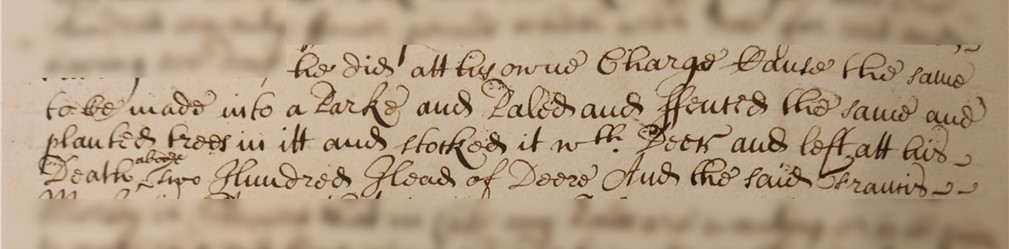
…he did att his owne Charge Cause the same to be made into a Parke and Paled and Fenced the same and planted trees in itt and stocked it w[i]th Deer and left att his Death above two Hundred Head of Deere…
The fabric of churches and faculties for alterations generated further suits, ranging from a case concerning the theft of lead from a church roof to disputes arising from church extensions. At St. Mary Abbots, Kensington, the building of a new aisle and the allocation of a gallery to seat schoolchildren led to a major dispute between its pew-holders. In several similar cases proprietors of pews enforced their rights by installing locks on their pews. Burials could also generate conflict. In a bizarre incident in the church at Llanganten, Brecon, Joanna Jones, looking to bury her husband, dug up the body of a child, ‘her body, flesh and hair … nay even the winding sheet being not near corrupted or putrefied but indeed her flesh being very green and raw’. Challenged by a witness for her barbarous dismembering of so fresh a corpse, Joan snapped back (in Welsh) that ‘if he thought there was any flesh to the bones … he might fetch some salt to season it’.
Marriage and divorce were again the subject of sensational cases. When Aubrey de Vere, Earl of Oxford, married his mistress, a claim arose that he was already married to Hester Davenport, an actress known as Roxalana, whom he had married in a chandler’s shop in Harts Horn Lane, London. Although Hester exhibited in court her gold wedding ring, inscribed ‘I will be true’, she lost her case. Other women were more successful. William Stokes, of Selling, Kent, and Edmund Hack, of Trowbridge, Wiltshire, both faced suits bought by their wives for nullity of marriage on grounds of their impotence. Ann Stokes underwent a medical examination by eight midwives, but William baulked at the ordeal of proving his virility before a posse of doctors and surgeons. After numerous warnings he was excommunicated and, remaining obdurate, was reported to the Crown for arrest and imprisonment. Edmund Hack ducked a similar medical examination in the hall of the Court; he died an excommunicate. One of the longest cases arose from the cruelty of Eustace Hardwicke of Littledean, Gloucestershire to his wife Elizabeth. His withholding of alimony – a further cruelty – brought the case before the court on 118 occasions over a period of seventeen years.
Clergy discipline was a further concern of the court, as in a bitterly fought case of simony against John Cawley, who had leased out his office as Archdeacon of Lincoln for £75 per annum. This case proved the limits of the Court’s authority. Although a sentence of suspension was passed against Cawley in the Court of Arches, and upheld on appeal in the Court of Delegates, he mounted a direct petition to the Crown, was re-instated, and remained Archdeacon until his death in 1709.
Richard Palmer, May 2023.
Richard Palmer will be giving a free public talk on Thursday 27th July 2023:
‘This august tribunal’ – The Court of Arches: sex, money and the church in the seventeenth and eighteenth centuries.
To book, please see the Library’s website:
The talk accompanies the Library’s exhibition: Moral and Material Decay: four centuries of the Court of Arches, which opens on 19th July 2023 in the Mezzanine Gallery.
 A Monument of Fame