
We are grateful to Maureen Palmer for writing this blog post.
At the end of May sixteen of the Friends of Lambeth Palace Library ventured across the Channel to visit the Alsatian City of Strasbourg. The trip was planned by John Critchley, who sadly died in December last year, and was greatly missed by us all. The trip was a very fitting legacy to him: superbly planned with every visit an absolute joy.
Our first visit was to the Bibliothèque Nationale et Universitaire (National Academic Library), an imposing Imperial German building on the exterior, but entering one realized that the whole of the interior had been rebuilt in the 1950s. The library has, like the city, a long history of conflict and in 1871, the German Government gave the city a library to replace one which had been gutted by fire in 1870. Appeals for books over the whole of Europe resulted in a sizeable library. The building was totally reconstructed in the 1950s and transformed again in 2010-2014. The outer shell was retained but the interior is safer and more useful. It is now the second largest library in France.
What treasure we were shown!

An 18th century pamphlet of Saints, the Lord’s Prayer and parts of St John’s Gospel, all folded into a convenient pocket-sized document.
I was especially interested in the pictorial encyclopaedia ‘Hortus deliciarum’ (Garden of Delights) of Herrad of Landsberg, a 12th century nun. It is a compendium of all the sciences studied at the time and written for the nuns of the convent to further the teaching of Biblical, theological and moral material. Sadly, the original was lost in the fire but the miniatures had been copied and published in 1818, so there is still a record of Herrad’s work.
The library holds not only precious books and manuscripts but also a unique collection of cuneiform tablets collected by a German expedition to Egypt and Syria in the 19th century. We were also interested in a paper globe (c. 1625) made by Isaac Habrecht II who was also the son of the maker of the astronomical clock in the Cathedral.
An extensive conservation area revealed a project to repair, with very thin Japanese paper and fixative, a precious map which had torn around the ink. The conservation theme here, as in most important libraries, was ‘preservation, curative treatment and major repair’.
A move to the Cathedral to see the Astronomical Clock strike 12.00 followed, and a very interesting and informative video provided the background. The clock was made in 1571-74 by Isaac and Josias Habrecht.
A guided tour of the Cathedral allowed us to enjoy the architecture and the stained-glass windows (image below): some made in 1298 but following fires and wars, many are copies and much more recent. The pulpit in the Cathedral was especially fine, designed by Hans Hammer in 1484 for the pre-Reformation preacher Johann Geiler of Kaysersberg. The carving was exquisite, lace-like, with statues of Apostles, Saints, Church Fathers, plants and animals, including Geiler’s dog! Its grandeur reflected the popularity of Geiler’s sermons in the vernacular.

Our day ended with a boat trip around the river and canal which totally encircle the city. We enjoyed the Tanner’s houses with the large openings which helped to dry the skins, part of La Petit France district where those suffering from syphilis could be isolated, and the important buildings of the European Parliament, the Council of Europe and the Human Rights building.
A wonderful and interesting day!
On Wednesday, a short train journey took us to Colmar, where we visited the Musée Unterlinden and the Dominican Library. The former was a Dominican community, founded in 1239 by two noble women – both called Agnes! The monastic buildings are preserved today and house the paintings of Martin Schongauer (c. 1450-1491), the Isenheim Altarpiece and so much else. The building suffered greatly during the French Revolution but the Schongauer Society wanted to gather the paintings, etchings and drawings of Schongauer into one place, and they were given to the Dominican convent.
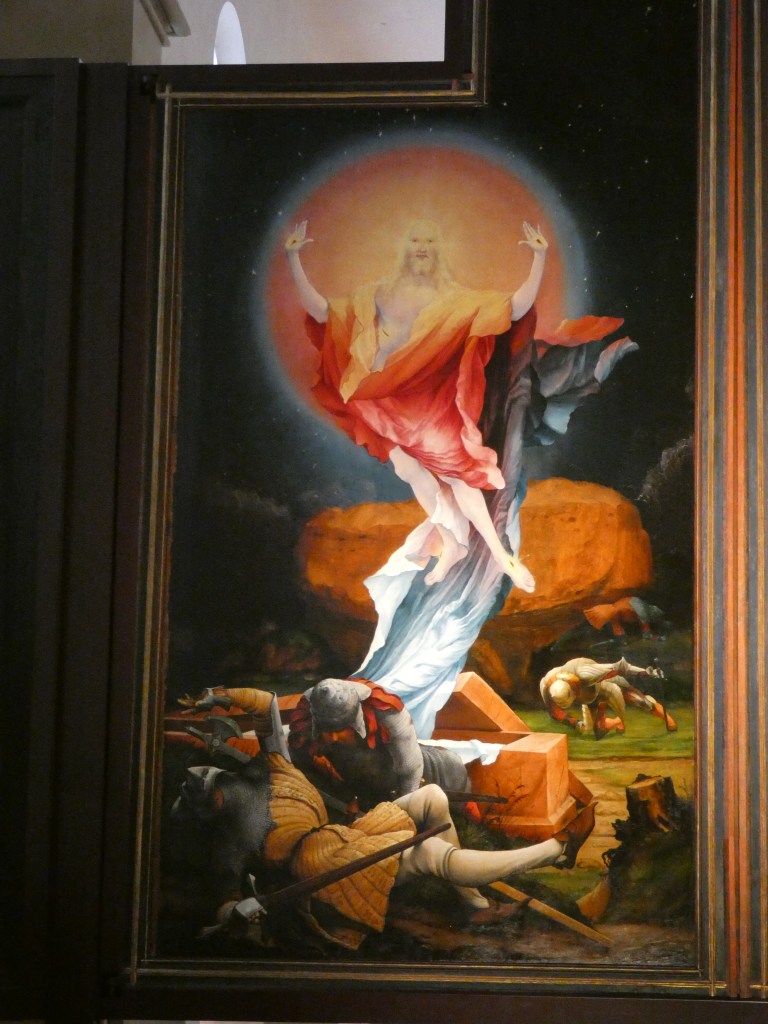
The Isenheim Altarpiece is an amazing work, now each panel separated so that the whole may be seen in sequence. It was painted by Matthias Grünewald (c. 1470-1528) and designed to comfort patients suffering from St Anthony’s Fire, a form of ergotism which causes convulsions, hallucinations and gangrene, so shows the suffering Christ and then the resurrection (image below). Prayers to St Anthony were thought to be curative, so he features prominently on the polyptych.
The visit to the Dominican Library was also a joy, and showed us early printed Bibles, especially one printed by Johannes Mentelin, a printer from Strasbourg; the first German-language printed book –‘Das Buch de Chronik et Geschichte’; a copy of the Nuremberg Chronicle, written by Hartmann Schedel in 1493, and so much else. As well as the printed material we saw a wealth of Breviaries, Graduals and Psalters, richly decorated and dating from the 14th and 15th centuries.
Thursday morning saw us at the Médiathèque André-Malraux in Strasbourg. The library is built in a former port area and canals, loading cranes, tracks and industrial buildings, from the 1930s, were renovated and are part of the landscape. The books are arranged on six floors and there are some 300,000 items. The library has a rich collection of musical manuscripts including some scores from musical theatre, little-known operas as well as books of plainchant, songs and arrangements. There is also a large collection of illustrated books for children. Strasbourg was the home of Gustave Doré, one of the important French artists of the 19th century, whose work is well-represented.
The highlight of the week for me was a journey to Sélestat to visit the Humanist Library. The library today embraces the Parish Church library and the private library of one of the town’s most illustrious inhabitants, Beatus Rhenanus (1485-1547). Beatus was the only surviving son of his family and after the death of his mother, his father focussed on making sure that he was given a good academic education. There was a Latin School in Sélestat, founded in 1441, and the library has one of Beatus’s school notebooks containing a passage given at dictation together with a commentary of the text – all meticulously written.
Following his education at Sélestat he went to Paris and then to Strasbourg where he proof-read texts for one of the printing houses. He was enormously influenced by the Humanist movement at Sélestat and on moving to Basel, befriended Erasmus who referred to him as his ‘alter ego’.
In addition to the notebook, other treasures included the oldest book in the library, a 7th century Merovingian Lectionary; a 12th Century Book of Prayers as well as a collection of Bibles which ranged from the Sorbonne Bible (image below) to a tiny Bible such as priests might take with them on a journey.

Beatus remained a Catholic but had many Reformers and Humanists among his friends.
The visit to Strasbourg was much too short to embrace all the treasures it had to offer – I guess most of us will be planning a return visit!
 A Monument of Fame