
By Wayne Fortune, Assistant Archivist
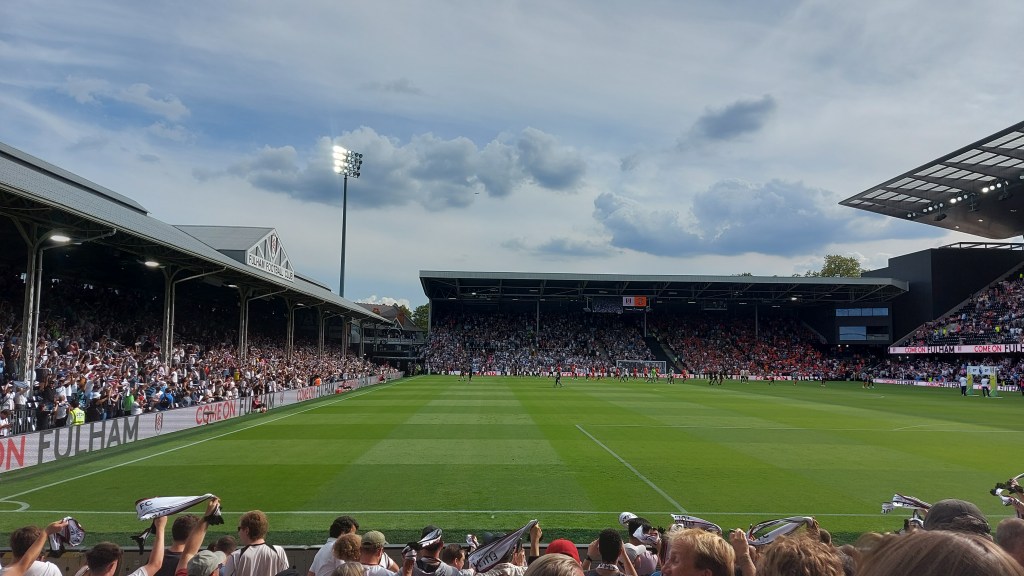
Craven Cottage, the home of Fulham FC, is one of the most famous football grounds in England, if not the world. For most of its history its freehold was owned by the Church through the Ecclesiastical Commissioners and the Church Commissioners, who had various interactions with the Club and its custodians over the 90 years they were its landlords. Records of this relationship can be found in the Ecclesiastical Commissioners administrative files and the recently catalogued Church Commissioners Assets Committee papers, providing a huge amount of information on the ownership of the ground, its development, and the activities of the Club.
Background and Early History
Situated on the banks of the Thames close to Fulham Palace, the original cottage was constructed by William Craven in 1780 as a notable hunting lodge, however by the mid-nineteenth century it had fallen into disrepair. In 1872 the Commissioners agreed a lease with Tod Heatley, with a covenant that he would rebuild the cottage. Work progressed slowly, with flooding a major problem, and in 1888 what was left of the original cottage burnt down leaving the site derelict.
During this time a sports club had sprung up in 1879 at St Andrew’s Church, Fulham Fields, playing cricket and football. They became known as Fulham Football Club in 1889, and having played at various grounds in the area, they were seeking a new home when they came across Craven Cottage and arranged to sublet it from Heatley. The site was so overgrown that it took two years to be made suitable for football to be played on it, with material excavated from the construction of Shepherd’s Bush underground station used to raise the level of the land above the river. Fulham’s first match at Craven Cottage took place on 10th October 1896, a 4-0 win against Minerva in the Middlesex Cup.
Having been in dispute over the lease and the fulfilment of its terms, Heatley and the Commissioners reached a settlement in 1897 with a longer period allowed to build on the site (until 1906) and granting that Heatley ‘pending the completion of the buildings is to be at liberty to use the property as a football ground’. Nevertheless, in the following in years the Commissioners’ agents Cluttons had difficultly collecting the rent due, and they were unhappy with structures which had been built at the ground.

The football club came to terms with Heatley to buy his interest in December 1904, and agreed a new lease with the Commissioners for a term of 99 years at £135 rent per annum. Two additional pieces of land from an adjacent farm tenancy were included to make the ground regular in shape. The lease included stipulations:
- to remove existing stands and buildings
- to construct new stands
- to reconstruct the slopes surrounding the ground
- to take down the corrugated iron fence and replace it with oak cleft fences or brick walls
- not to use the ground on Sundays for football/cricket/tennis
- not to use the ground for any purposes other than sports
The construction carried out to fulfil these stipulations included the surviving, and iconic, pavilion (often referred to as ‘the cottage’) and the Stevenage Road Stand (now called the Johnny Haynes Stand), both designed by legendary football ground architect Archibald Leitch. Interestingly, the lease allowed the Club to give one months’ notice to stop football use of the ground, surrender the lease, and enter a Building Agreement to build twenty houses on the land.
Activities
Correspondence in the archive records various interactions between the Club and the Commissioners on a range of topics relating to the use of ground. For example, in the 1930s neighbours complained about noise pollution from the Tannoy system and paper litter in the streets after matches, and it was mooted that motorcycle speedway would be held at the ground, which the Commissioners decided they would not grant permission for. There were attempts to set up a supporters’ social club in the 1960s, with the Commissioners granting permission for the Club to hold a licence to serve alcohol.
Perhaps the most interesting episode came in 1980 when the Club asked the Commissioners to relax the clause in their lease which prohibited the use of the ground for sport on Sundays so that rugby league could take place. Although Hammersmith Council and the police were amenable to the idea, some local residents were opposed and gathered a petition, and also wrote to the Archbishop of Canterbury. When the lease had been approved in 1968 the Assets Secretary told the Club that ‘if professional football on Sundays is legalised then a licence (for Sunday play) will be granted’, so following changes to the Sunday Observance Act 1780 the Commissioners felt they had an obligation to allow it. They noted that the lease contained a prohibition of nuisance, annoyance or disturbance, so they could intervene and revoke the licence if necessary. By the time the Assets Committee met to ratify the decision the first match had taken place – the Secretary attended in order to report back (Fulham RLFC beat Wigan 24-5).[1]
Ownership Enquiries
The bulk of the records in the archive concern the ownership of the freehold of the ground. First in 1927, then on several occasions over the coming decades, the Club made enquiries about purchasing the freehold from the Commissioners, all of which were rebuffed. Although the Commissioners auctioned off much of the land they owned in the area in the late 1950s, they declined to include Craven Cottage. In the records the Commissioners often express concern that the value of the site would be much higher if used for a residential development compared to its use as a football ground and they felt any price agreed to sell the freehold would have to reflect this – for a long time this effectively secured the use of the site for football purposes.
In 1967 the Club decided to modernise facilities at the cost of more than £100,000. Their lease had only 37 years to run and to justify this expenditure they once again asked to either buy the freehold, or to arrange a new lease. Citing the proximity to Fulham Palace, the Assets Committee refused to sell but authorised negotiations for a new long lease, with a strong covenant against the use of the land for anything other than football.[2] The paper circulated to members of the Committee notes Fulham’s position in the league table, perhaps indicating their interest in the football as well as the property!

A new lease was approved by the Assets Committee in 1968 at £1500 annual rent for the first seven years, £2000 for the second seven years, then £2500 until 2004 with a full rent review every fourteen years thereafter.[3] The lease was finally signed in 1971, running until 2094, and the club embarked on construction of the Riverside Stand, a requirement of the agreement.
The Club made an offer of £55,000 (well above Cluttons’ valuation of £14,000) to purchase the freehold in 1975, with the stipulation that the conveyance would not contain a clause reserving a share of future profits for the Commissioners if the ground was sold for housing, but in any case assuring the Commissioners that the Club had no intention of doing so. However, the Assets Committee decided that there was something to be said for retaining the freehold and that they valued their close association with the Club, so would not sell unless the Club could show it was being seriously disadvantaged by the situation. In addition, the offer was ‘too low for a property of this size and position’.[4] The Club asked the Commissioners to reconsider as their bank preferred the freehold as collateral in raising money to rebuild one of the stands. The Assets Committee declined considering the value of potential future development on the land but intimated they would reconsider should they receive an improved offer.[5]
Supporter Concerns
The Committee of a Fulham Supporters Group wrote to the Commissioners in 1978 saying they feared the motives of the Club’s owners – that their aim was to buy the ground and then sell it for residential development. They described the Club’s owners as ‘not longstanding Fulham fans’ who would ‘put financial gain before any moral duty to the Club’s supporters’ and asked the Commissioners not to sell the freehold to the Club’s owners or ever permit building on the ground. Throughout 1979-1980 the Club continued to enquire about the sale of the freehold and possible terms of a conveyance.
Conclusion
The culmination of the ownership struggle began in 1981: the Club offered the Commissioners £275,000 for the freehold, with plans to redevelop the Putney End of the ground – with residential spaces included – and needed the freehold for security. The Commissioners were still not willing to sell but were open to the redevelopment. The saga rumbled on over the following years, and the archives contain a lot of detail on this, including plans for the proposed stand. There is much discussion regarding incorporating the Riverside Walk along the north side of the Thames, a Greater London Council project, as part of the redevelopment.

Falling spectator revenues and the cost of erecting the Riverside Stand had undermined the Club’s financial position, and on the 22nd November 1984 they offered £900,000 to buy the freehold, via an option at a cost of £20,000 with the purchase to be completed within six months. The Club was keen to pursue the redevelopment scheme but had been unable to agree a variation in their lease allowing it, as Cluttons (i) considered the plan financially inviable and (ii) thought ‘the relatively high density of the proposed scheme would effectively blight the future redevelopment of the remainder of the site’. The Assets Committee agreed to grant the option, reasoning that ‘to turn down the Club’s offer would invite the accusation that a struggling football club had been denied the opportunity to better its financial position’.[6]
The option agreement was completed on 16th January 1985, but even before the sale went through the Club began receiving offers from house builders for the land. Stories in the press speculated the Club would sell up and move to a new site in Wormwood Scrubs, possibly to share with QPR.
A letter was sent to Archbishop Runcie in early 1985 protesting the sale, arguing it would lead to the demise of the Club, while other protest letters were sent to the Commissioners. In early July 1985 the option agreement was extended by three months at cost of £15,000, with the purchase price now £950,000.

The sale was finally completed on 20th July 1985. Immediately the press revealed that an advance from developers had financed the deal – reports suggested that Fulham would remain at Craven Cottage but sell off areas around the perimeter of the ground for housing. The press also questioned aspects of the deal, with distinguished football writer Brian Glanville writing to the Commissioners calling the amount received ‘peanuts’; their reply pointed out that higher valuations of the land assumed planning permission would be granted.
Indeed, planning permission for the proposed redevelopment was rejected, and Fulham slipped towards going out of business. The owners subsequently sold the Club to a group who intended to sell the ground and pursue a merger with QPR. The Assets Committee meeting of 19th March 1987 noted press reports about the sale of Craven Cottage for housing development – the minutes state that the Commissioners were the previous owners of the ground, had a neutral stance on whether football should continue there, and that they sold their interest for a ‘very satisfactory figure’.[7]
Subsequently the Club and ground was saved and restructured by a consortium including the former player Jimmy Hill; Fulham continue to play at Craven Cottage and are currently rebuilding the Riverside Stand, with the design including some residential spaces…
References:
1. CC/A(80)MTG9
2. CC/A(67)MTG5
3. CC/A(68)MTG4
4. CC/A(75)MTG16
5. CC/A(76)MTG4
6. CC/A(84)MTG9
7. CC/A(87)MTG3
Background reading: Peter Lupson, Thank God for Football!, London: SPCK, 2006. [LPL: LV941.L8]
 A Monument of Fame