
By Amanda Lancaster
As part of my conservation course requirements at City & Guilds of London Art School, I joined the Collections Care team as a student placement in June 2023. I chose Lambeth Palace Library as a placement opportunity because of its unique collection and emphasis on the care and conservation of its objects and materials. After nearly 7 weeks with the team, I am leaving with an excellent appreciation for the inner workings of libraries and a greater understanding of conservation approaches in an archive setting.
During my time at the Lambeth Palace Library conservation studio, I had the opportunity to work with a wide breadth of objects, such as printed books, architectural plans, legal documents, and various manuscripts. I was exposed to a great number of materials, from tracing paper to parchment and leather in a variety of conditions, as well as a variety of situations in a busy working library environment, such as exhibitions, handling training, and assisting reader requests. I was able to apply what I’ve learnt from my training but was also challenged to try new treatment techniques or new equipment (such as the Zund box-making machine). Below are a few project highlights from my time in the studio this summer.
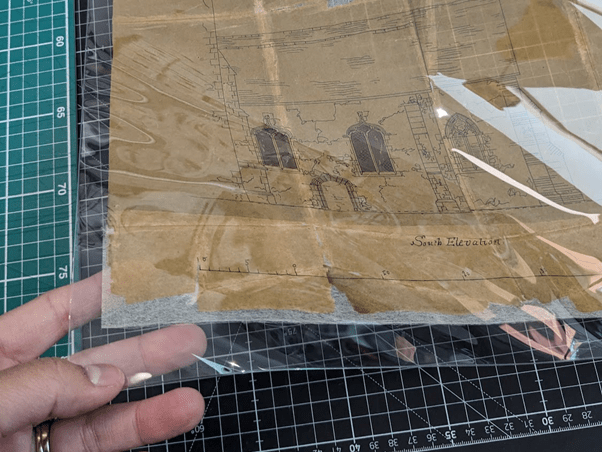
Working with acidic tracing paper – Chancel Plans
The Chancel Plans project is an ongoing multi-year project to conserve a collection of plans from various parish churches. These architectural plans were drawn up on a variety of paper substrates, and I worked on a few plans on extremely acidic tracing paper. The objective of this project was to enable each item to be handled, catalogued and, ultimately, used by a reader. Therefore, the most important thing was to ensure that any image or writing was preserved. Broken pieces of paper were put back together using strips of 7.3gsm Tengu tissue for support, which was adhered using non-aqueous 3% Klucel G in ethanol to speed up the evaporation rate and minimise moisture contact and possible tidelines. Once all fragments were reinstated, the plans were inserted into Melinex sleeves to enable handling for cataloguing.


Working with parchment – Court of Arches
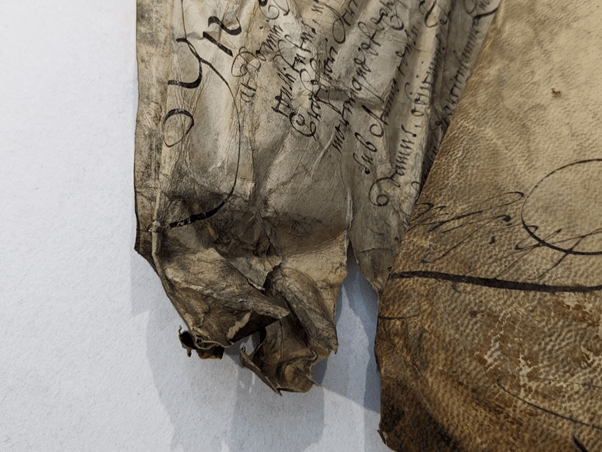
It was a particular treat to be able to work on a couple of parchment documents this summer. It is a distinctive material, quite different from paper or leather, so it has a unique set of requirements and considerations in its treatment. I worked on two parchment documents from a collection of legal documents from the Court of Arches Bbb series. The documents are stored in bundles as they relate to specific court cases, which means many of the larger parchment documents are used to encapsulate the small documents and thus suffer from some handling damage. The two documents being treated suffered from extreme dirt, creasing, and large tears and losses. After cleaning, the parchment was locally humidified. I used a 4% agarose gel for one document and Nevek (a gel in propanol) for the other depending on the condition of the parchment and how much moisture it needed or was able to take. After gentle humidification, the parchment was dried under weights overnight to ensure it dried in the right position. It was important not to flatten the parchment as it needed to retain its folds for storage, so any repair needed to take this consideration into account. The losses were infilled using toned Gampi paper to reduce the contrast between the repair tissue and the parchment material.


Working on a fire-damaged book – Sion College Collection
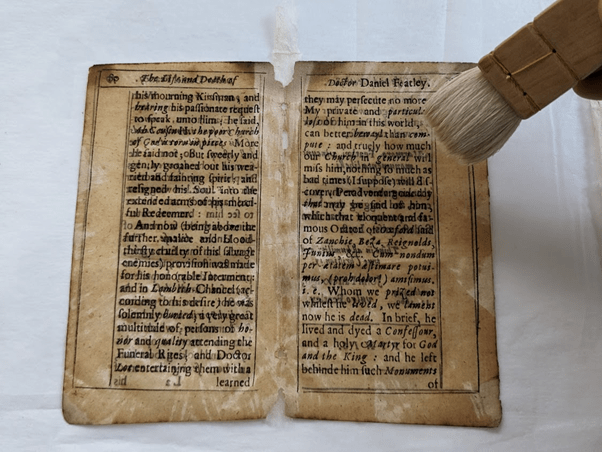
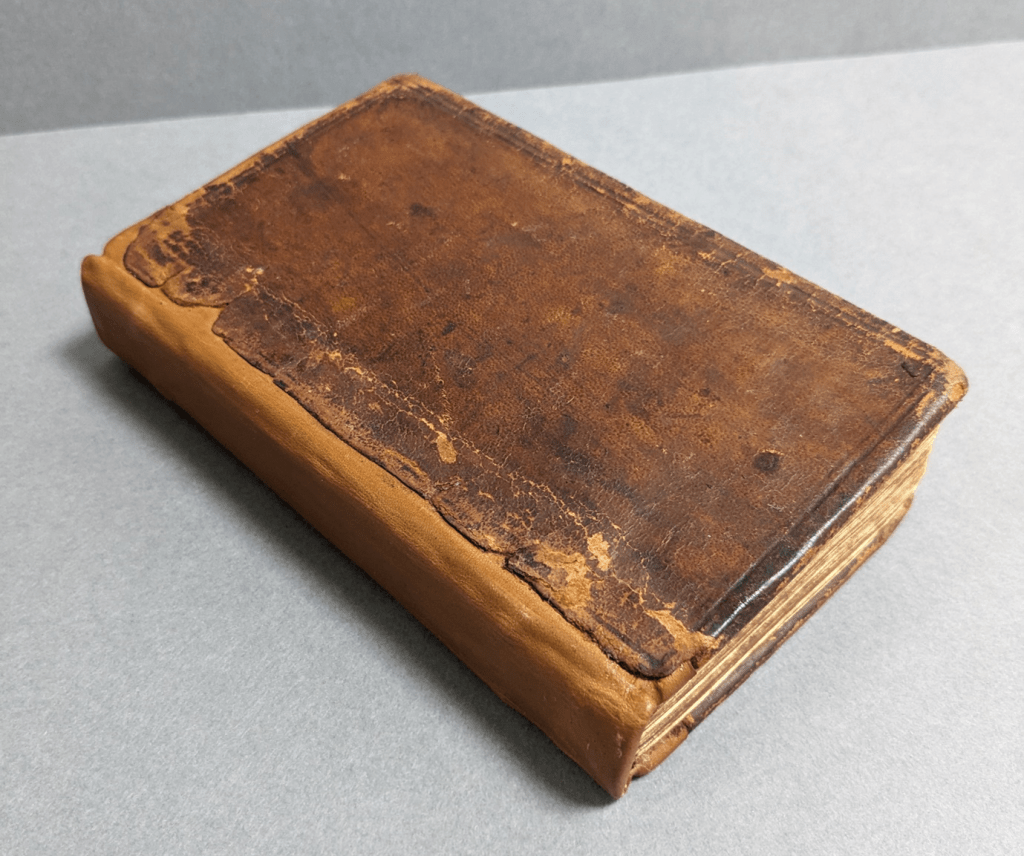
I rebacked a small fire-damaged book from the Sion College Collection, A69.9/F31. This book was extremely brittle with detached boards, broken sewing, textblock break, and dehydrated leather. After surface cleaning and leather consolidation, I guarded the damaged leaves and infilled areas of loss to prepare the gatherings for sewing. I learned how to support extremely brittle paper using 3gsm tissue, as well as techniques to dye very thin tissue! We plied linen thread into linen cord, which is a stable archival material for a sewing support. I learned how to use leather fibres to infill leather losses, which was a highly effective technique to use like-for-like material (and sustainable!), and also ways to visually minimise my repairs. This project has helped to build my confidence. Although I have rebacked leather-covered books previously, I learned so many new techniques to help refine my skills through this project.


I have learned an immense amount from everyone at Lambeth Palace Library, not just the Collections Care team. Everyone has been extremely generous with their time and in sharing their knowledge (I learned so much about cataloguing), and it was very inspiring to be surrounded by people who were so passionate about the library and the collections. I’d like to extend my thanks to Lara Artemis and the Collections Care team for having me. And also a special thanks to Talitha Wachtelborn and Meagen Smith, my supervisors on these projects, for their support and guidance during my time at the library.

 A Monument of Fame