

By Sarah Griffin (Assistant Archivist), Camille Koutoulakis (Digital Officer) and Meagen Smith (Conservator)
In Summer 2023, the Lambeth Bible left England for the first time to feature in the exhibition Normands. Migrants, Conquérants, Innovateurs in Rouen. Before leaving Lambeth the entire manuscript was digitised, and it is now available on our digital repository for all to enjoy. To celebrate its online release, the staff of Lambeth Palace Library have been reflecting on what it’s like to work with one of our most treasured manuscripts: capturing its glittering images and documenting its condition in fine detail, ensuring it is safely preserved for another 800 years.
What is the Lambeth Bible?
The Lambeth Bible (MS 3) is one of around a dozen giant Romanesque Bibles that survive from England and alongside the Winchester Bible and Bury Bible, is one of the most finely illuminated. The manuscript is full of vibrant images decorated with gold, including six full-page paintings and twenty-four historiated initials, just a few of which are featured below. Lambeth Palace Library holds the first volume (containing Genesis to Job) while the second is in Maidstone Museum & Art Gallery (MS P.5). The two volumes were reunited at Lambeth Palace in 2013.

The exhibition to which the Bible was loaned, held at the Musées des Antiquités and des Beaux-Arts, highlighted the rich links woven between Normandy and the rest of the world between the ninth and twelfth centuries. For the first time, the Lambeth Bible was displayed beside the only other known examples of illumination by its main artist: two exceptionally well-preserved fragments of a Gospel book, now held by La Société Archéologique in Avesnes (images below). The Gospel book was made for the abbot of Liessies in Hainault (northern France), whereas the Lambeth Bible was probably made in southeast England.


Digitising the Lambeth Bible
The Lambeth Bible consists of 328 leaves of vellum measuring about 52 x 35 cm. The best way to demonstrate the magnitude of its size is to show it ready for its photoshoot in the library studio.


Just as the production of a giant Bible was labour intensive in the 12th century, so was its photography in the 21st. Over the course of three astounding days, the text, full-page miniatures, and decorated and historiated initials revealed themselves to us. Our task: to create digital copies that record the Bible digitally, in all its splendour and imperfections, to create a record as accurate as possible to the original, and to capture the quality of this masterpiece of medieval art for everyone to enjoy. This all starts with clarity and colour.

When photographing Lambeth Palace Library’s illuminated manuscripts, we first prepare the book in a way that best captures the clarity of the lines, the vibrancy of colour hues and its glimmering gold. Capture One software allows us to isolate, in real-time, an array of hues and check that tones and shades of colour documented by our camera are precise. In some cases, the true primary colours need adjusting and levelling to control how colour contrasts react with one another and other secondary colours when photographed.

This is not as simple as a ‘point and shoot’ operation. It is a technical and meticulous task and once it is successful light and colour can transcend their pixels to form a picture that displays the artistic accomplishment of each design. Photography gives us incredibly detailed information to study the legacy of giant Bibles and record the artisanry of the parchment in a completely new light. It allows us to highlight visual information as it has never been seen, and serve as a means to compare zoomed-in close ups of the many hands that painted the Bible.
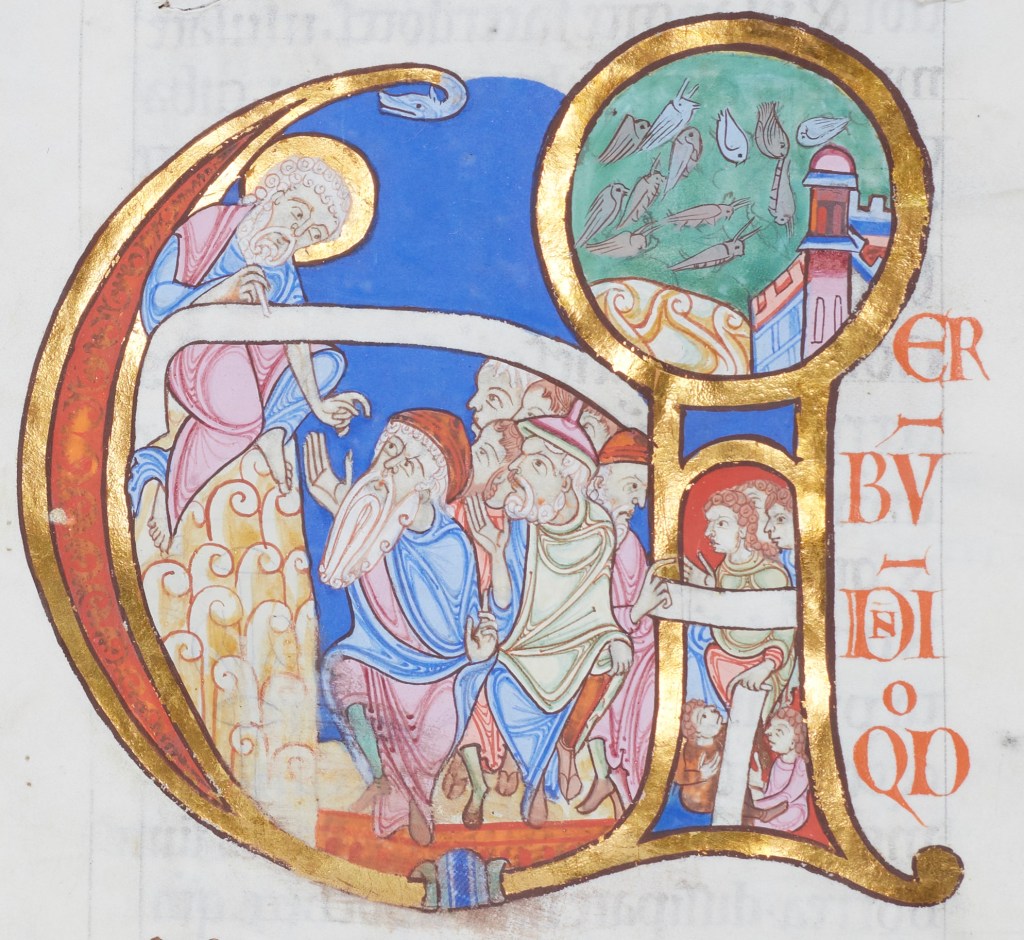
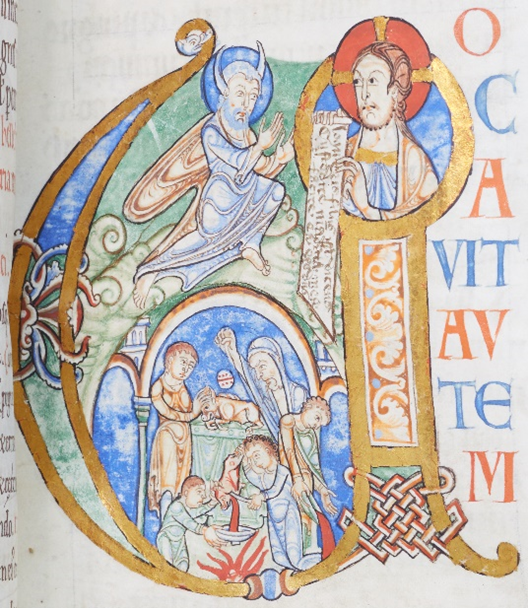
Right: Initial containing a horned Moses communicating with God (detail of MS 3, f. 52r)
All the details and nothing but the details: Collections Care and the Lambeth Bible
A core part of preparing an item for loan to another organisation is condition documentation in written, photographic and diagrammatic formats. For each item we lend, we prepare a formal condition report that describes features and flaws and their locations, like areas of discolouration or, for the Lambeth Bible, large areas of undulating parchment (see upper and lower left corners of the image below). This process ensures we can identify any changes that may happen during the stages of sending an exhibition loan including packing, shipping, installing and display. Documentation is needed to manage risk, track changes (including fading due to light exposure) and for insurance purposes. We write the documentation to ensure curators and couriers can understand our observations for checking the object and authorising its loan.
For the Lambeth Bible, we described a wide variety of material characteristics relating to the binding and the textblock, whether they were stable or vulnerable including creases, folds, staining, tears, loss to illumination, pigments and ink. In addition to marking up a photograph, we describe what we are observing textually as images do not always fully represent the features in question. With a particularly complex item, like the Lambeth Bible, we work across the team to ensure our documentation is consistent. We share the tasks of observing and recording both writing and diagrammatically while working in pairs.

Our imaging colleague Camille takes a set of pictures that we use to produce our diagrams. We overlay printed versions of the photos with plastic sheets on which we draw our observations. Depending on the complexity of the item, we may label each of the areas indicated or when particularly dense, as in the featured picture, we number the markings to improve overall legibility. By the time the Bible was ready to be couriered to Rouen, all our qualified conservators: Ari, Avery, Fiona, Lara, Meagen and Tal, had spent time on the documentation.
While condition documentation can be a time intensive activity in a busy Collections Care studio, it offers an opportunity to spend time looking at potentially magnificent and compelling items in fine detail. Being able to record the effects of time and handling on one of our treasures was a rewarding three days.
Select Bibliography
Christopher de Hamel, ‘The Lambeth Bible’ in Lambeth Palace Library: Treasures from the Collection of the Archbishops of Canterbury (London: Scala, 2010), pp. 40-43.
Christopher de Hamel, ‘Who Commissioned the Lambeth Bible?’, Lambeth Palace Library Annual Review (2013), pp. 79-96.
Dorothy Shepard, Introducing the Lambeth Bible: a study of texts and imagery (Turnhout: Brepols, 2007)
 A Monument of Fame