
By Arianna Mangraviti, Preservation Assistant
In the current exhibition, ‘Her booke’: Early Modern Women and their Books at Lambeth Palace Library, curated by Dr Julia King and Emma Anderson, the selection of material on display reveals a vivid picture of the life of women from the early modern period (c. 1450 – c. 1800). The books on display were all owned, made, commissioned, written, or printed by women, allowing us to admire illuminated manuscripts, early printed books, prayer books, unpublished manuscripts and first editions. Working in preparation for an exhibition such as this is a wonderful opportunity for the Collections Care team. It gives us a chance to examine elaborately decorated books closely, and allows us to reflect on the historical context and cultural significance of the volumes and documents.

As part of our work to support exhibitions, in Collections Care we review the condition of items selected for display, noting physical damage such as tears, mould and dirt, as well as the condition of bindings, pigments, and inks. Fortunately, the majority of the items in this exhibition are in good condition, but some items needed closer attention. Keeping accurate records is vital throughout; the condition of volumes is recorded before items go on display, and is documented again at the end of the exhibition, to check whether their condition changes.
There are, of course, several measures that we take to reduce the chance of damage occurring during the exhibition process. We carefully plan how to support items on display and customise book cradles to support the spines at the appropriate openings. Lux levels, or the levels of light to which an item is exposed, are low so that beautiful illustrations do not fade due to light exposure. The display cases monitor the climate (temperature and relative humidity) and control the relative humidity, helping us to manage the risk of further damage caused by fluctuating environmental conditions to our collections whilst they are on display.

Before installing ‘Her Booke’, leading on the preparations for items to be safely displayed, Meagen Smith, Conservator, showed our new Collection Care Assistant, Grace Howson, some of the specific processes we use to ensure items are fit to display. This covered a range of stabilisation treatments undertaken in the Collections Care studio, where we all allocated time to providing a range of conservation treatments that aim to extend an object’s lifespan. For example, we located paper tears in pages that needed support to prevent the tears from extending. We place strips of polyester across pages to help hold the book open whilst on display. However, when doing this it is essential to ensure the paper is in sound condition, as the strip may scratch and tear fragile material.
Two volumes on display in this exhibition had more extensive damage and required re-backing which involves replacing the leather positioned over the spine of the volume. Talitha Wachtelborn, Sion College Library Project Conservator, worked on the Sion collection volume and I treated a work by Hannah Allen titled Satan his methods and malice baffled…, printed in 1683 (F980.A5). The spine was severely degraded with no original material left. The upper board was detached and distorted, the title page was partially detached, and the corners were delaminated.
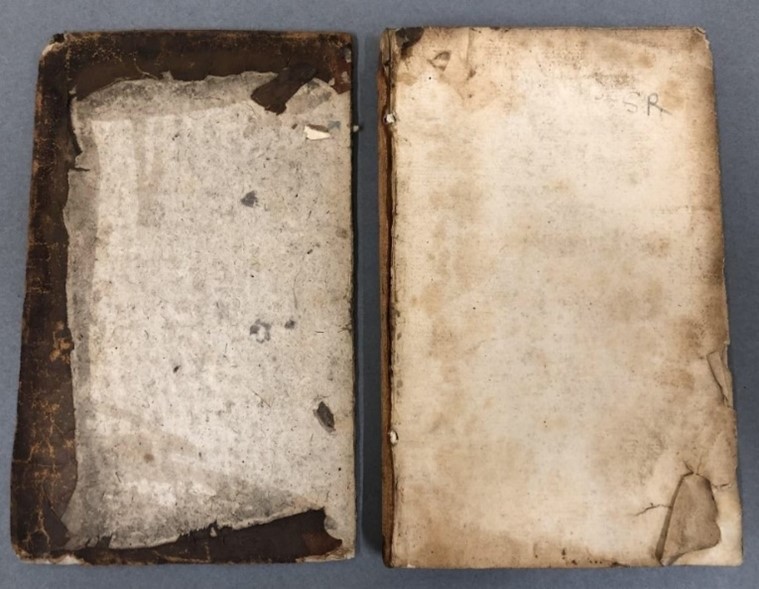
Fiona Johnston, Conservator, who leads on the conservation of our printed book collection, worked with me to flatten the distorted paste paper board, in order for it to be reattached to the textblock. The technique involved introducing moisture via damp blotting paper in a controlled, gradual manner. This reduced the deformation and flattened the board, whilst not damaging the leather at the front.
For the re-back, I used archival grade calf leather, which I dyed brown to match the leather on the board using specialist dyes. I repaired the board’s delaminated corners using wheat starch paste, before covering them with toned paper.
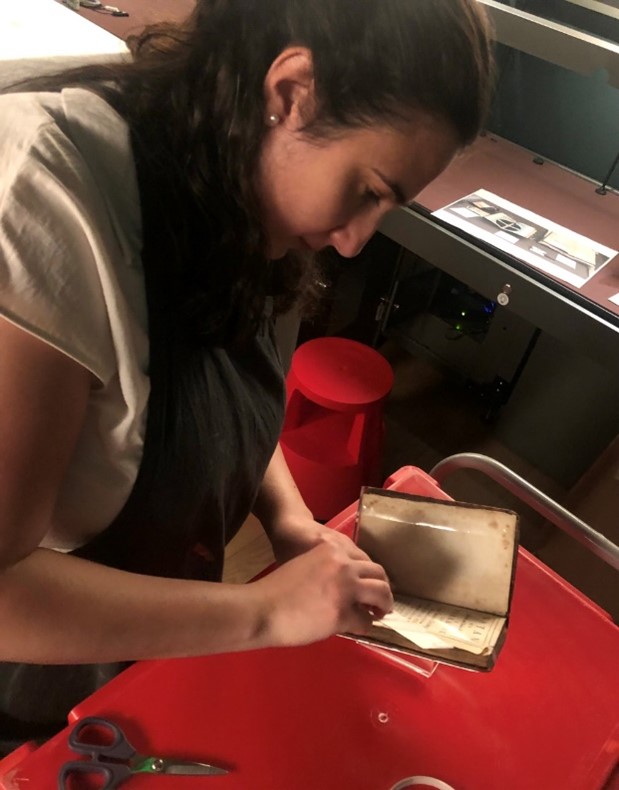
After treatment, the book was ready to be installed in our museum-standard display case. The treatment will also enable readers to access the book in our reading room after the exhibition ends.
Reflecting on the preparation for ‘Her booke’, exhibitions provide a perfect opportunity for the Library’s teams to collaborate and spend time together. Overseen by Lara Artemis, Senior Conservator, Collections Care works as a team and with our talented colleagues including archivists, librarians, a digital imaging officer, and operations and communications experts, as well as our facilities, hospitality and security teams. It is both enjoyable and enriching to exchange expertise and knowledge for the benefit of the collections and our professional development. Through the many relationships we develop across teams where collaboration has become key, between us we ensure collections are safely and accessibly displayed. This enables us to showcase the range and depth of subjects our wonderful collections hold to the wider public.

‘Her booke’: Early Modern Women and their Books at Lambeth Palace Library is open from 1 July – 21 November 2024 from 9:30 – 17:00, Monday to Friday.
It will also be open on selected Saturdays, including 3 August, 7 September, 5 October, 2 November. For more information and to view our schedule of events and lectures, please visit: https://www.lambethpalacelibrary.info/exhibitions/her-booke/
 A Monument of Fame