
Our guest contributor, Dr Kathleen Doyle (retired Lead Curator of Illuminated Manuscripts at the British Library), guides us through the contents of concertina-fold calendars printed in England, two of which are featured in Unfolding Time.
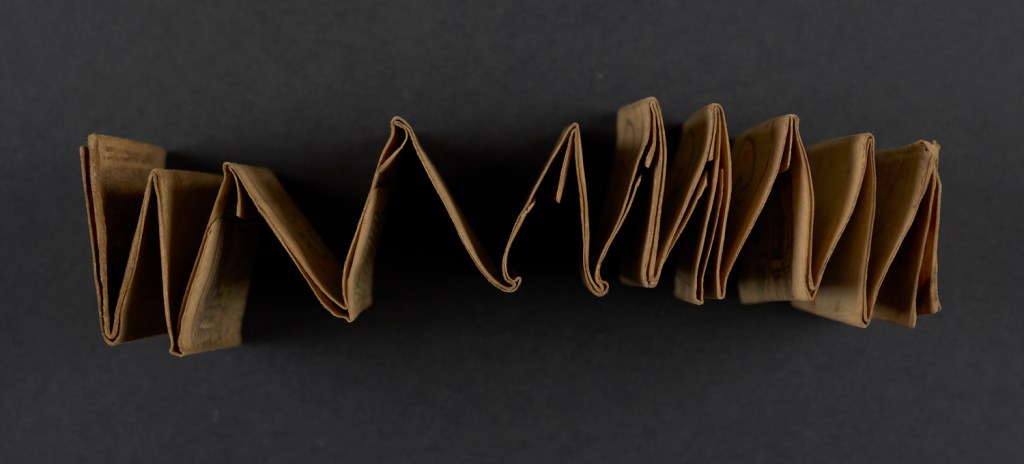
One of the exciting aspects of the Unfolding Time: The Medieval Pocket Calendar exhibition, now open at Lambeth Palace Library, is the opportunity to see unusual, folded manuscript almanacs side-by-side with two copies of a rare and relatively unknown folded printed version.
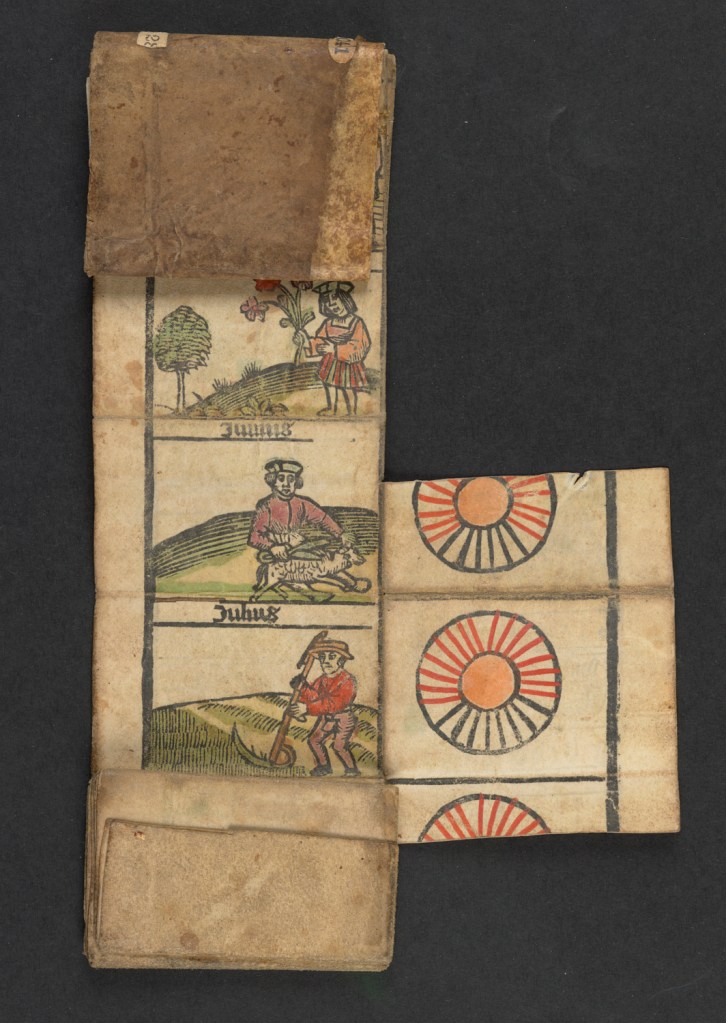
Just ten copies of an English pocket calendar made using woodblocks survive. The exhibition features two of them, now in the British Library, neither of which have ever been on display before. Yet, even though they are printed, they are not identical, because each has certain names and numbers that were filled in by hand, and were hand-coloured with colour washes. They are printed on both sides of a long piece of narrow parchment—that is, animal skin—rather than on paper, probably using only one long woodblock. Both displayed copies are still folded, and one has a leather pouch.
The contents of these wood-block printed almanacs are more abbreviated than most of the manuscripts in the exhibition, but they share the principal element of the manuscript folding books—a month by month calendar on one side, together with scenes of the relevant activity or ‘labour’ of the months on the other. All of the printed copies were designed to be read from the top of the narrow strip to the bottom. On the ‘exterior’, opposite the labours are circular rotas or diagrams, sometimes referred to as ‘sun wheels’, that give the number of hours of daylight and darkness in the relevant month, presented as coloured spokes of a wheel, with red spokes at the top indicating the number of hours of daylight and black spokes printed at the bottom for the number of hours of darkness. And like their manuscript predecessors, although the labours on either side of the central fold relate to the same month as on the inside, when folded these cannot be read together, without turning the almanac over and unfolding the opposite side.
The ‘inside’ of the printed almanacs has four parts. At the top is a table designed to help determine that date of Easter, above a large circular diagram or ‘sun chart’, for the entire year, as a kind of summary of the smaller sun wheels or rotas on the exterior. The diagram is divided into twenty-four sections with twelve concentric circles of the number of hours of daylight and darkness for each month, beginning with January in the outermost circle.
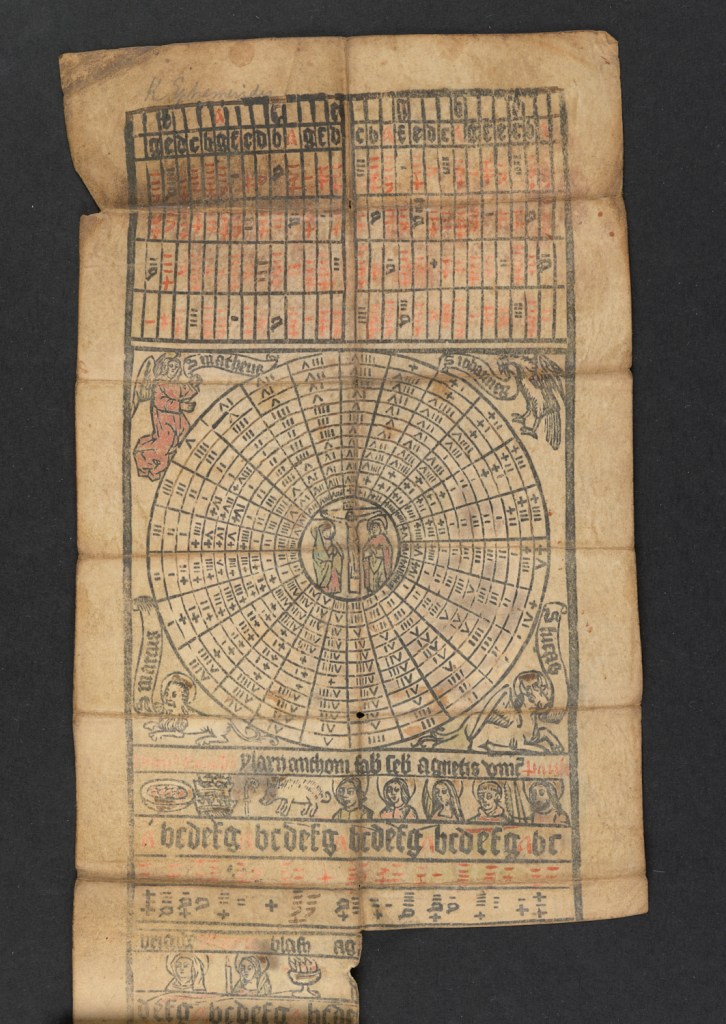
In addition, if viewed akin to a modern clock face, with midnight at the top, the sun chart also provides the approximate hour of sunrise and sunset for each month, by reference to the position of the beginning of daylight or darkness hours on the rota. Within the innermost circle is the Crucifixion with the Virgin Mary and St John; at the corners are the symbols of the Evangelists holding scrolls identifying each by their names in Latin.
Below this diagram is a perpetual calendar, so-called because it includes all of the saints’ days and other feasts, such as Christmas and Epiphany, that are celebrated on the same date every year, together with information necessary to calculate the moveable feasts. Each month is spread out horizontally over the width of the strip in one row. The names of the saints or feasts appear at the top, above an image or pictogram of the relevant feast, connected by black or red lines (corresponding to the colour of the saint’s name) to a letter identifying the day of the week, from a to g. Both the names of the more important saints and holidays and their corresponding connecting lines were added in red by hand in each copy. In the image below, which features December, Christmas is pictured as the newborn Jesus in a manger, with a red line beneath that connects the feast to the letter b on the 25th day of the month.

At the bottom, below the month of December there is a short chronological table identifying selected biblical and English historical events. This table supplements the daily and monthly information of the calendar with an illustrated historical perspective of the past as a sort of timeline, or summary world chronology. The table is arranged in three columns, featuring a label or short explanation of the event with a number in roman numerals on the left, a corresponding modified roman numeral in the centre, and the small pictograms on the right.
It includes six biblical or quasi-biblical events: the creation of the world; Adam and Eve’s ages; the number of years that Adam was in Hell before the Incarnation; the number of years since the Flood; and the number of years since the Incarnation. Each of these is illustrated by a pictogram representing the event: a circular map of the world, divided into three parts; a bust for Adam and for Eve; an animal face with a large mouth and curved fangs, presumably representing a Hell mouth for Adam’s time in Hell; the Ark for the Flood; and a swaddled Child for the Incarnation. If each print was prepared in the year given as the number of years since the Incarnation, as seems probable, then the chronicle table above dates the concertina to 1538. Each copy ends with two English post-biblical historical events, the number of years since the martyrdom of Thomas Becket, represented by a mitred bust, and the number of years since the coronation of a king, represented by a crowned bust.
Don’t miss this opportunity to see these fascinating objects, on display until 15 May in Lambeth Palace’s free exhibition, Unfolding Time. For opening times, see https://www.lambethpalacelibrary.info/unfolding-time.
Further reading:
Kathleen Doyle, ‘Opening Up Representations of Saints in English Folded Manuscripts’, in Opening Manuscripts: Tributes to Elly Miller, ed. by Stella Panayotova, Lucy Freeman Sandler and Tamar Wang (London: Harvey Miller, 2024), pp. 66-87.
Kathleen Doyle, English Xylographic Folded Almanacs, forthcoming in 2026.
 A Monument of Fame