
By Kwesi Ochosi, Project Spire Coordinator: Archives
“Those who opposed him were caught up in their own world. British society of the nineteenth century was overwhelmingly racist, deeply hierarchical… The idea that an African was their equal was literally, unimaginable… They lived in an age of certainty in their own superiority. In their eyes not only the gospel, but even the Empire would be at risk if they conceded…”[1]
In 2014, Archbishop Justin Welby took the first reparative steps towards addressing a historic wound that had been festering for over a century. He was speaking at a special commemorative service of thanksgiving at Canterbury Cathedral to honour the life and work of Bishop Samuel Ajayi[2] Crowther, the “Bishop of the Niger”. Not only did Welby’s sermon offer an honest apology for the structural racism that Crowther experienced as the first consecrated African in the Anglican Church – but he also preached a message of self-reflection and repentance for the Church of England, in acknowledgement of lingering discrimination that impacts the Church and wider society today.
Bishop Samuel Ajayi Crowther’s early biography is well known. He was born around 1809 in Osogun, in present-day Oyo State, Nigeria, among the Yoruba people. He was given the name Ajayi by his family, which he tellingly kept throughout his life. As a 12-year-old boy, he was captured as a prisoner during the Yoruba wars and sold into racialised chattel slavery in 1821. While being trafficked to the Americas aboard the Portuguese ship, Esperanza Felix, young Ajayi and hundreds of other Africans aboard nearby vessels were rescued by HMS Myrmidon and HMS Iphigenia of the Royal Navy’s West Africa Squadron, and transported to the British colony of Sierra Leone.[3] To put these events into context; the insidious system of providing European colonial powers with enslaved African labour had been established for over 300 years – and although Britain would fully emancipate all enslaved Africans within its colonies in the Americas by the late 1830s,[4] had Ajayi been captured 15 years earlier, the British themselves would have been competing with Portuguese enslavers for his purchase.[5]
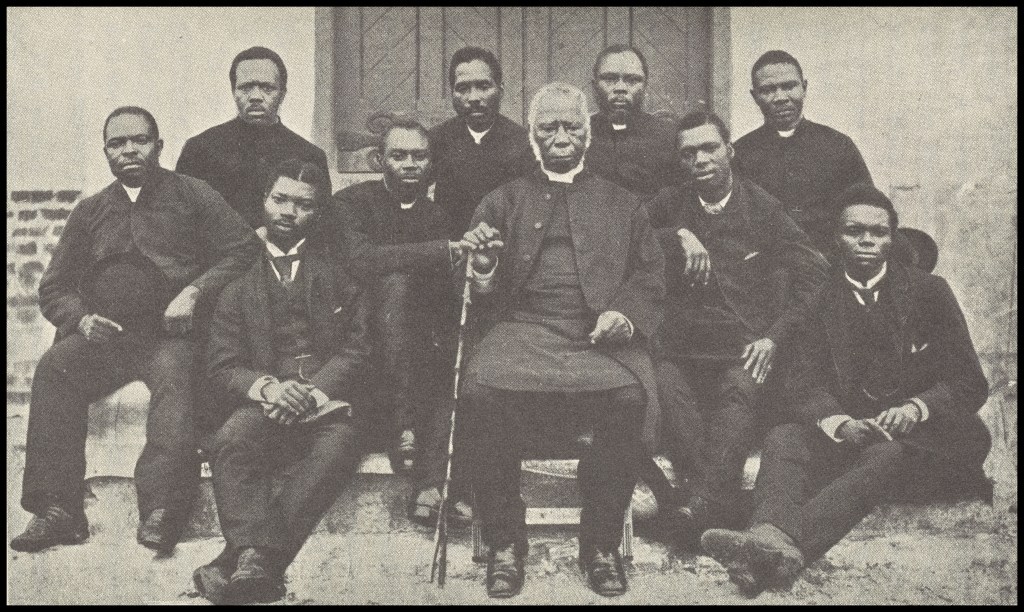
Upon arrival in Sierra Leone, Ajayi came under the influence of missionaries from the Church Missionary Society (CMS). He was baptised in 1825, and received the name Samuel Crowther, after an Anglican clergyman and early supporter of the CMS. Now known as Samuel Ajayi Crowther, he received a formal education through the CMS schools of Freetown. Recognised at an early age for his exceptional intellectual gifts, Crowther set sail for England in 1826 for further study. Upon his return go Sierra Leone he became the first student of the Fourah Bay Institution, established in 1827 as the first colonial-era higher education institution in West Africa. Crowther was eventually ordained in the Church of England in 1843 by the Bishop of London, and became a pioneering missionary scholar, producing grammars and dictionaries, and playing a leading role in the translation of the Bible and Book of Common Prayer into Yoruba. In recognition of these achievements, the University of Oxford awarded him a Doctor of Divinity degree in 1864. During a visit to Britain in 1851, Crowther met Queen Victoria at Windsor Castle and recited the Lord’s Prayer in Yoruba – which she reportedly described as a “soft and melodious” language.
In 1864, under the auspices of the CMS, Crowther was consecrated at Canterbury Cathedral as Bishop of the West African territories beyond the Diocese of Sierra Leone. Better known as the Bishop of the Niger, Crowther was widely recognised as the first African Anglican bishop, and eventually established a mission largely staffed by indigenous African clergy and catechists. Together, they played a crucial role in spreading the Gospel throughout the region, as they navigated the Niger and Benue Rivers and their tributaries, building a vast, maritime missionary network as they went. In honour of his pioneering work, Crowther was awarded a gold watch by the Royal Geographical Society.
Bishop Crowther set out his vision for the Niger Mission in a pastoral charge published in 1866, advocating for spreading the Christian Gospel alongside education, agriculture and economic development.[6] His advocacy for “the Bible and the Plough” was an African manifestation of the vision of Sir Fowell Buxton, and the “Native Church” philosophy of Revd Henry Venn – two senior CMS officials who strongly supported his mission. Crowther’s pairing of “Christianity and Industry” reflected his belief that African Christians must play the leading role in using legitimate local commerce to break the economic dependence created by three centuries of global chattel enslavement.
However, back in London, CMS officials were growing increasingly uneasy about the prospect of African self-determination and independence. Spurred by European colonial rivalries and imperial ambitions, supportive CMS officials like Buxton and Venn were gradually replaced by a younger generation of zealous leadership (the so-called “Sudan Party”) who openly questioned the competence of Crowther’s “Native Church” and pressed for greater European control of the region. Towards the end of his life, Crowther was effectively stripped of his authority as Bishop, with financial, administrative and missionary decision-making placed into the hands of European personnel. Among Crowther’s dwindling defenders was CMS Secretary Robert Cust, who challenged the racialised criticisms of his colleagues, and argued for the continued importance of African-led clergy in Africa.[7]
By the late 1880s the “Scramble for Africa” was well underway in the Niger region, principally in the form of Sir George Goldie’s Royal Niger Company. One telling incident concerned the Preparandi, a vocational and practical training complex established by Crowther for local Africans in 1887. Deemed as too grandiose for African use by the Sudan Party, the buildings were sold to Goldie, who subsequently used them as military barracks, contributing to the formal colonisation of the region by British forces. As CMS leadership continued to give way to demands for Imperial expansion, the convergence of racial prejudice, missionary betrayal, and British colonial interests effectively destroyed the foundations of the African-led, self-governing Church that Crowther had spent decades building along the Niger – culminating in his resignation as Bishop in 1890.
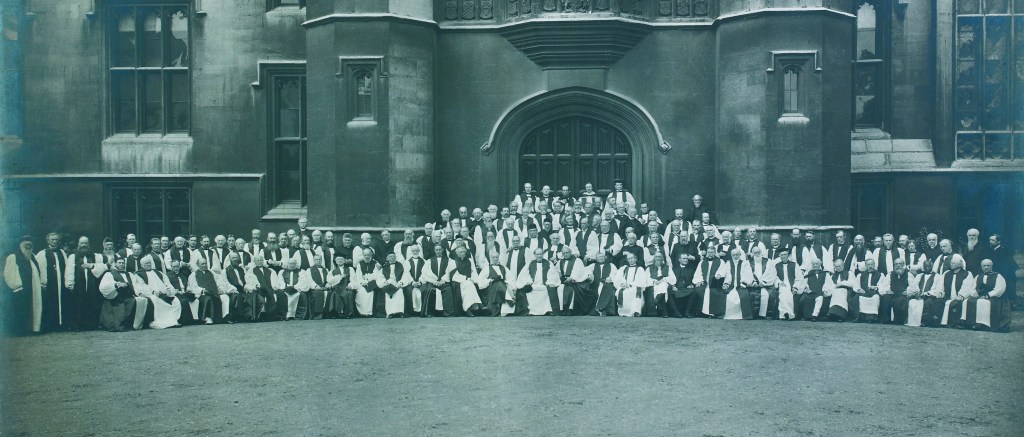
Despite the sabotage of his life’s work at the hands of the Church, Bishop Samuel Ajayi Crowther was ultimately vindicated by those who honoured him as the “Apostle of the Niger”, and the founder of African Anglicanism. While his works are not free from criticism – including his controversial use of “Èṣù” to render “Satan” in his Yoruba translation of the Bible, a choice criticised for demonising a Yoruba deity – his sincere advocacy for African self-determination in the wake of racialised chattel enslavement helped to sow the seeds of the independence movement that swept the region in the decades after his death.[8]
More broadly, the journey of young Ajayi from a Portuguese slave vessel to the Bishopric of his ancestral homeland should lead us all to raise questions that extend beyond his lifetime. From an archivist’s perspective, what does justice require when an institution has helped to create, and subsequently obscure, a documented history of racial injustice? The Church of England’s recent work, including Project Spire, and its wider programme of truth-telling, healing, repair and justice, demonstrates an increasing willingness to confront its historic links to the racialised chattel enslavement and colonisation of African people, and to examine what those histories mean for the Church and wider society today. As Archbishop Sarah Mullally has boldly put it, “the Church cannot undo its history, but it can choose how it responds to it.”[9] Indeed, the past cannot be changed, but the integrity with which it is remembered by institutions, and the choices made in response to the truths brought to light from the archives, can certainly change the present. In doing so, we can contribute to creating the future conditions for genuine repair for us all.
Bishop Crowther’s life and work is further explored in our latest exhibition, Mariners: Religion, Race and Empire at Lambeth Palace Library. The exhibition is open until Friday 11 September, and is presented in collaboration with the University of Bristol.
[1] https://www.anglicannews.org/news/2014/06/archbishop-welby-on-the-first-black-anglican-bishop.aspx [Accessed 28/08/2026]
[2] The Yoruba name “Ajayi” was historically rendered in English as “Adjai” in most 19th century sources.
[3] Martinez, Jenny S., The Slave Trade and the Origins of International Human Rights Law (Oxford: Oxford University Press, 2014), pp. 3-15. O3267.M2S5 2012
[4] The 1833 Slavery Abolition Act introduced the system of apprenticeship; whereby formerly enslaved Africans/people of African descent were required to work up to 45 hours per week for former enslavers for up to six years without compensation. The system was abandoned due to widespread resistance.
[5] Despite the 1833 Slavery Abolition Act, British corporations continued to engage in the racialised chattel enslavement of Africans long after 1833. For example, https://www.theguardian.com/world/2026/aug/23/british-corporation-continued-trafficking-of-enslaved-africans-to-guyana-40-years-after-abolition-reveals-letter [Accessed 28/08/2026]
[6] Crowther, Samuel Ajayi, A Charge Delivered on the Banks of the River Niger in West Africa (London: Seeley, Jackson & Halliday, 1866). H5034 56.11
[7] CMS Secretary Cust’s letter to fellow CMS Secretary Revd Lang. Benson 165, ff. 32-34
[8] The Niger Mission Question: Being Reprint from “The Lagos Times”; also “The Memorial from Lagos to the Church Missionary Society” and “The Address Presented to the Right Rev. Dr. Crowther”. Printed by the Lagos Times Printing Establishment, 1892. Benson 165, ff. 2-27
[9] https://www.churchofengland.org/media/news-and-press-releases/bishop-sarah-mullally-archbishop-canterbury-elect-responds-parliamentarians-letter-regarding-church [Accessed 28/08/2026]
 A Monument of Fame